Compare every way to travel between Makkah and Madinah in 2026 — Haramain train times and fares, private transfers, buses and flights, plus costs, booking tips and station advice.
The roughly 450-kilometre stretch between Makkah and Madinah is one of the most travelled corridors in the Muslim world, and getting it right can shape your entire trip. Pick the wrong option and you lose half a day to road traffic or wrestle suitcases across three different vehicles. Pick the right one and you move between the two cities in comfort, with time to rest before your next prayer at the Haram.
This guide breaks down every realistic way to make the journey in 2026 — the Haramain high-speed train, private cars, intercity buses, and the limited role of flying — with real travel times, current price ranges, booking steps, and the practical details that the glossy brochures leave out. It's written for international travellers who want to plan with confidence, whether you're on Umrah, performing Hajj, or simply visiting the holy cities.
Quick answer: what's the fastest and easiest way?
For most travellers, the Haramain High-Speed Railway is the fastest option, covering the city-to-city run in about 2 hours 20 minutes to 2 hours 30 minutes. A private car transfer is the most comfortable door-to-door choice, taking roughly 4 to 5 hours but with no station changes or luggage drama. Intercity buses are the cheapest but slowest at 5 to 6 hours, and flying is rarely worth it because Makkah has no airport.
The best choice depends on your group size, budget, and how much luggage you're carrying. Solo travellers and couples usually win with the train; families and older pilgrims often prefer a private vehicle.
The four ways to travel between Makkah and Madinah
Here's how the main options compare at a glance. Costs are indicative for 2026 and shift with season, demand, and exchange rates — Hajj, Ramadan, and school holidays push prices to the top of each range.
| Option | City-to-city time | Typical cost | Door-to-door? | Best for |
|---|---|---|---|---|
| Haramain train | 2h 20m – 2h 30m (station to station) | SAR 150–300 per person | No (station transfers needed) | Solo travellers, couples, speed |
| Private car / transfer | 4h – 5h | SAR 300–900 per vehicle | Yes | Families, elderly, lots of luggage |
| VIP / intercity bus | 5h – 6h | SAR 85–100 per person | No (bus stations) | Budget solo travellers |
| Flight (via Jeddah) | 5h+ with connections | High and inconvenient | No | Almost no one |
The sections below go deeper into each, starting with the option most travellers reach for first.
Option 1: The Haramain High-Speed Railway
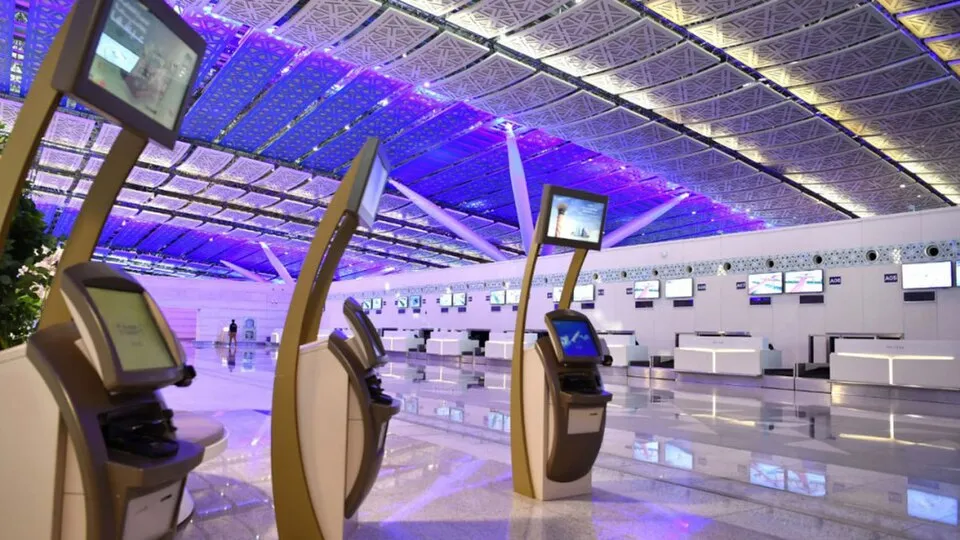
 Air-conditioned Haramain coaches with reclining seats make the city-to-city run comfortable.
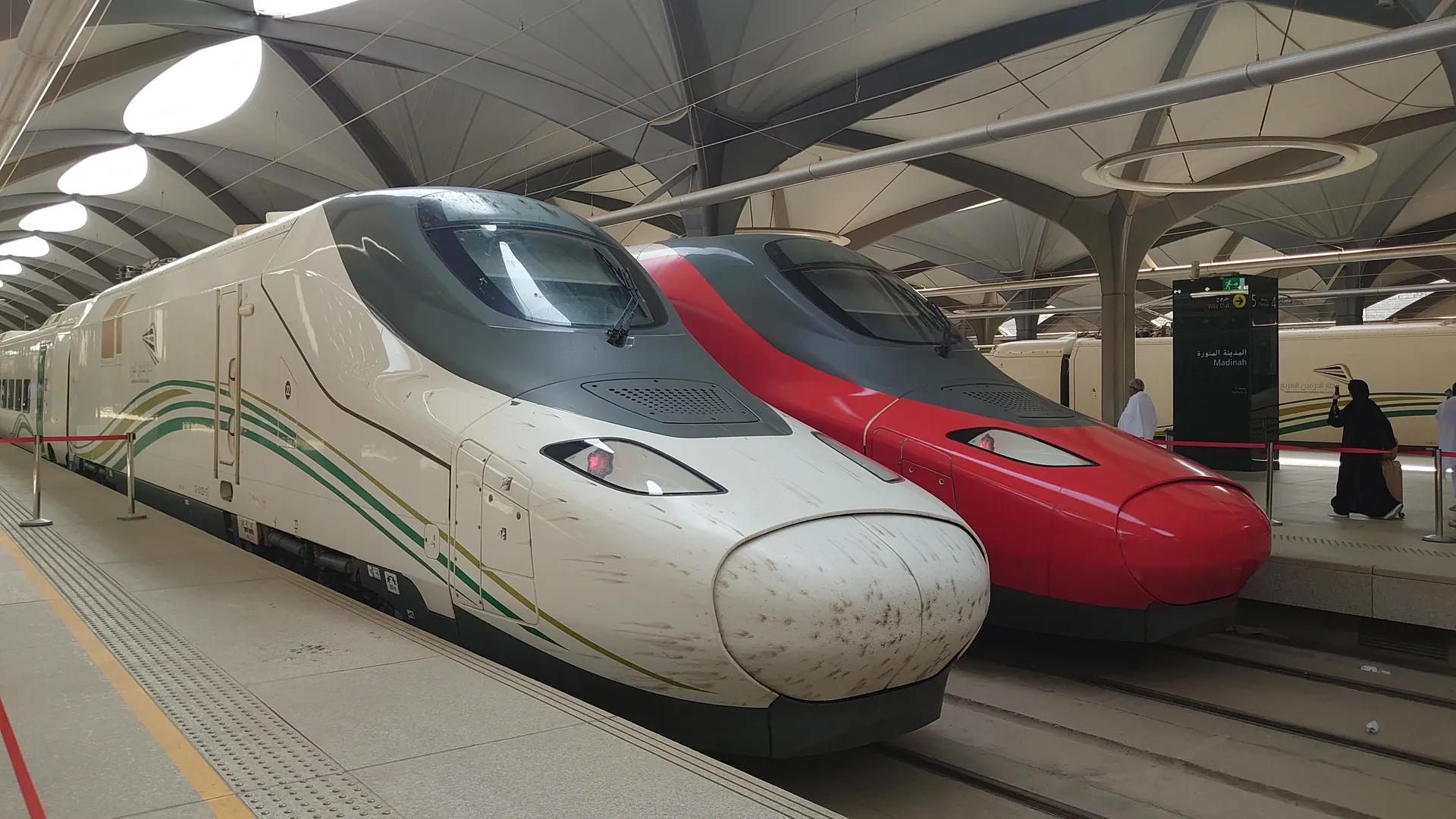
The Haramain High-Speed Railway (often shortened to HHR or simply "the Haramain train") is operated by Saudi Arabia Railways and is the flagship intercity line of the Kingdom's Vision 2030 transport push. It opened to the public in October 2018 and was extended to Jeddah's King Abdulaziz International Airport in late 2019. Trains run at speeds of up to 300 km/h, which is what compresses a five-hour road slog into a two-and-a-bit-hour glide.
The route and stations
The line runs 450 km from Makkah to Madinah with three stops in between. There are five stations in total:
- Makkah (in the Rusaifah district, not next to the Haram)
- Jeddah – Al Sulaymaniyah (central Jeddah)
- King Abdulaziz International Airport (KAIA) — Jeddah's airport
- King Abdullah Economic City (KAEC)
- Madinah
Most services run as fast direct trains between the major cities; some call at every station. When you book, the journey time shown tells you which type you're getting, so check before you pay if speed matters.
Travel time and fares
The Makkah–Madinah leg takes around 2 hours 20 minutes on a direct service. Expect a little longer on trains that stop at intermediate stations.
Fares are sold in two classes — Economy and Business — and they move with date and demand. As a 2026 guideline for the Makkah–Madinah route:
| Class | Typical one-way fare | Approx. USD | What you get |
|---|---|---|---|
| Economy | SAR 150–200 | ~$40–53 | Comfortable seat, AC, restrooms, cafeteria access |
| Business | SAR 250–300 | ~$67–80 | Wider seats, more legroom, quieter coach, priority boarding |
Children aged 2–11 usually travel at around half the adult fare, and infants under two go free if they sit on a lap rather than taking their own seat. During Hajj and Ramadan, fares climb sharply and popular departures sell out days ahead, so book early in peak seasons.
How to book Haramain train tickets
You have a few options, in rough order of reliability:
- The official Saudi Arabia Railways website and app — the source of truth for live schedules and the cheapest fares. This is where you confirm prices before committing anywhere else.
- Self-service kiosks at the stations — fine if you're flexible on timing, risky in peak season when trains fill up.
- Licensed travel agents and trusted booking platforms — convenient for groups or if you want everything bundled, though they may add a service fee.
Whichever route you choose, you'll receive a QR-code e-ticket. Bring your passport (or Iqama if you're a resident) for the boarding and security checks at each station, and arrive 30 to 60 minutes before departure because every station has airport-style screening and boarding gates that close ahead of time.
Luggage rules to know before you pack
The Haramain train applies airline-style baggage limits, which catches a lot of first-timers off guard. The standard allowance is one large bag (around 65 × 55 × 35 cm, up to 25 kg) plus one piece of hand luggage — a backpack, laptop bag, or handbag. Oversized suitcases can be refused at the gate, so if you're travelling with a lot of shopping or zamzam water, factor that in. This is one of the strongest arguments for a private car if you're hauling heavy bags.
The catch: getting to and from the stations
Here's the detail that train fare comparisons quietly skip. Neither Haramain station sits next to the holy sites. The Makkah station is roughly a 15–30 minute drive from Masjid al-Haram, and the Madinah station is about 20 minutes from the central Markazia area near Masjid an-Nabawi.
That means a typical train journey is really three legs: a taxi from your hotel to the station, the train itself, then another taxi to your destination hotel. Each taxi leg can run SAR 40–50, and you'll load and unload your luggage three times. For a solo traveller this is a minor hassle. For a family of four with suitcases, those extra taxis erode both the time saving and the cost advantage — which is exactly why many families choose the next option instead.
Option 2: Private car or transfer (door-to-door)
 A private car is the door-to-door alternative — no station changes, no boarding gates, no luggage limits.
A private transfer is the most comfortable way to move between the cities. A licensed driver collects you from your hotel lobby, you load your luggage once, and you're dropped at your destination hotel's door — no stations, no boarding gates, no rebooking if you're running late.
The drive covers about 450 km and takes 4 to 5 hours depending on traffic and how many rest stops you make. You control the pace, so you can stop for prayer, food, or to enter ihram at the miqat (more on that below) without negotiating with a bus schedule.
Indicative 2026 pricing, charged per vehicle rather than per person:
| Vehicle | Typical capacity | Approx. cost (whole vehicle) | Best for |
|---|---|---|---|
| Sedan | 3–4 passengers | SAR 300–450 | Couples, small families |
| SUV / GMC | 6–7 passengers | SAR 800–900 | Larger families, groups with luggage |
The per-vehicle pricing is the key insight: split four ways, a sedan can match or beat the all-in cost of four train tickets plus six taxi legs — and it's door-to-door. For elderly travellers, anyone with mobility issues, or families with young children, the comfort and simplicity usually justify the price even when it's a little higher.
Always book through a licensed operator with proper vehicles and visible reviews rather than flagging an unmetered car at the kerb. Confirm the price, vehicle type, and whether a miqat stop is included before you set off. You can arrange a vetted transfer on our transport page.
Option 3: Intercity buses
The bus is the budget choice. Note that the state operator SAPTCO stopped running its direct Makkah–Madinah service in 2022, largely because the Haramain train absorbed that demand. Today the intercity route is served by private operators such as Darb Alwatan and Northwest Bus Company, with both standard and VIP coaches.
Expect to pay roughly SAR 85 for a standard seat and SAR 100 for VIP, with the journey taking 5 to 6 hours including a rest stop and the transfers at each end. VIP coaches offer larger seats, Wi-Fi, and a meal, but the realities are the same as the train's "last mile" problem: buses depart from city bus stations that aren't next to the Haram, so you still need taxis on both ends, and the schedule is rigid — miss your departure and the bus leaves without you.
Buses make sense for solo travellers and couples watching every riyal who don't mind a longer day and a couple of extra taxi rides. For everyone else, the modest saving over the train rarely justifies the extra two to three hours on the road.
Option 4: Flying (and why it usually isn't worth it)
Travellers sometimes ask about flying between the two cities. The short answer: Makkah has no airport, so there is no direct Makkah–Madinah flight. Madinah is served by Prince Mohammad Bin Abdulaziz Airport (MED), while the nearest airport to Makkah is Jeddah's King Abdulaziz International (JED).
To "fly" the route you'd drive or train from Makkah to Jeddah, clear airport check-in and security, take a short flight to Madinah, then transfer into the city — a chain that easily runs five-plus hours and costs far more than the train. Flying only makes sense if you were already routing through Jeddah for other reasons or arriving internationally into one city and departing from the other. For the city-to-city hop itself, the train or a private car wins every time.
Which option is right for you?
A quick decision guide based on who you're travelling with:
- Solo traveller or couple, light luggage, want speed: Take the Haramain train in Economy. It's fast, comfortable, and cheap once you factor in just two taxi legs.
- Family of three or more, or travelling with elderly relatives: Book a private SUV transfer. Door-to-door comfort with one luggage load is worth the premium, and per-person it's competitive.
- Tight budget, time-flexible, don't mind transfers: Consider a VIP bus, but compare the all-in cost against a discounted Economy train ticket first.
- Carrying heavy or oversized luggage (lots of zamzam, shopping, gifts): A private car sidesteps the train's strict baggage limits entirely.
Getting to and from stations and airports
Because every train and bus journey involves transfers, sorting out local transport in advance saves real stress.
Inside both cities, ride-hailing apps work well and are usually cheaper and less stressful than haggling with street taxis, especially with luggage. Having the apps installed and a working data connection before you arrive makes the station transfers painless.
If you're arriving internationally, most Umrah travellers land at Jeddah (KAIA) for Makkah or directly at Madinah (MED). From KAIA you can take the Haramain train straight into Makkah (around 50–70 minutes) or book a private airport transfer to your hotel — our full guide to getting from Jeddah Airport to Makkah compares every option. From Madinah airport it's a short transfer into the city centre. Booking your airport transfer ahead of time means a driver is waiting when you clear immigration rather than negotiating a fare at midnight after a long-haul flight.
To pick a base that keeps station transfers short, see our round-ups of the best areas to stay in Makkah for Umrah and the best areas to stay in Madinah near Al-Masjid an-Nabawi.
Staying connected: get a Saudi eSIM before you travel
Almost everything in this guide — booking train tickets, calling a ride to the station, navigating to a private transfer pickup, checking live departure times — depends on having data the moment you land. Rather than hunting for a physical SIM at the airport or paying steep roaming charges, the easiest solution for most international travellers is a Saudi eSIM you activate before you leave home.
A travel eSIM gives you a local data allowance the instant you arrive, works alongside your home number, and means you can book that station taxi or pull up your QR ticket without scrambling for Wi-Fi. Look for a plan with enough data for maps and app use across your whole trip; most Umrah travellers find a mid-size data package comfortably covers a week to ten days. Our guide to the best Saudi Arabia eSIMs for Umrah compares plans and data sizes, or you can pick one up on our eSIM page and activate it before you fly.
Practical traveller advice
A few hard-won tips that make the journey smoother whichever option you choose:
Mind the miqat if you're heading to Makkah for Umrah. Travellers going from Madinah to Makkah to perform Umrah enter the state of ihram at the Dhu'l-Hulayfah miqat (also called Bir Ali), just outside Madinah. If you're on the train, change into ihram before you board, since stopping isn't an option. In a private car, ask your driver to stop at the miqat — most do this as standard. This is the single biggest reason families travelling for Umrah lean toward a private vehicle over the train.
Book peak-season travel early. During Hajj, Ramadan, and school holidays, both train seats and good drivers get scarce and prices rise. Reserve well ahead rather than turning up on the day.
Carry your passport, not a photo of it. You'll need physical ID for boarding checks at train and bus stations. A photo on your phone won't always cut it.
Travel light on the train. Re-read the baggage limits above before you commit. If you've stocked up on zamzam water and gifts, a private car removes the problem.
Build in buffer time around prayers. The train runs strictly to schedule and won't wait for you. Plan your departure so you're not rushing wudu or a prayer to make a gate that's about to close.
Keep your e-ticket QR code accessible offline. Save a screenshot in case your connection drops at the station — though a good eSIM makes that far less likely.
Hotels: where to stay on each end
Where you sleep affects how painful those station transfers are. In Makkah, staying in the Ajyad or Clock Tower area near Masjid al-Haram keeps you close to the Haram, though it's still a 15–30 minute ride to the Haramain station — factor that taxi into your departure timing. In Madinah, the Markazia (central) zone around Masjid an-Nabawi is the most convenient base, with the train station about 20 minutes away.
If you have an early train, choosing a hotel with a reliable concierge or one that can pre-arrange a taxi to the station saves a stressful morning. Many Umrah packages bundle hotels in both cities with transfers included, which can be the simplest path of all if you'd rather not piece the logistics together yourself.
Frequently Asked Questions
How far is Makkah from Madinah?
Makkah and Madinah are about 450 kilometres apart by road. The Haramain train covers a similar distance and completes the journey in around 2 hours 20 minutes, while driving takes roughly 4 to 5 hours.
How long does the Makkah to Madinah train take?
A direct Haramain High-Speed train takes about 2 hours 20 minutes to 2 hours 30 minutes between Makkah and Madinah. Services that stop at intermediate stations take a little longer.
How much is a train ticket from Makkah to Madinah?
In 2026, expect roughly SAR 150–200 for Economy and SAR 250–300 for Business one-way, depending on the date and demand. Prices rise during Hajj, Ramadan, and holidays, so book early and confirm the current fare on the official Saudi Arabia Railways site.
Is it better to take the train or a private car between Makkah and Madinah?
The train is faster and cheaper for solo travellers and couples with light luggage. A private car is more comfortable and often better value for families, since it's door-to-door, has no strict baggage limits, and the per-vehicle cost splits across passengers.
Can I travel from Madinah to Makkah and enter ihram on the way?
Yes. Travellers going to Makkah for Umrah enter ihram at the Dhu'l-Hulayfah (Bir Ali) miqat near Madinah. On the train, change into ihram before boarding; in a private car, ask the driver to stop at the miqat, which most include as standard.
Is there a direct flight between Makkah and Madinah?
No. Makkah has no airport, so there's no direct flight. You would have to travel to Jeddah airport first, making flying slower and more expensive than the train or a private car for this route.
How much luggage can I bring on the Haramain train?
Generally one large bag (around 65 × 55 × 35 cm, up to 25 kg) plus one piece of hand luggage per passenger. Oversized suitcases may be refused at the gate, so a private car is the safer choice if you're carrying a lot.
Do I need a SIM card or eSIM for the journey?
It's strongly recommended. Booking tickets, hailing taxis to and from stations, and checking live schedules all need data. A Saudi eSIM activated before you arrive is the easiest way to stay connected from the moment you land.
How early should I arrive at the Haramain station?
Arrive 30 to 60 minutes before departure. Stations have airport-style security and boarding gates that close ahead of the train, and trains leave strictly on schedule.
Final word
For most international travellers, the decision comes down to two strong options: the Haramain train for speed and value, or a private transfer for door-to-door comfort. The train is hard to beat if you're light on luggage and travelling solo or as a couple, while families and older pilgrims will appreciate skipping the station shuffle with a private car. Buses save a little money at the cost of time, and flying simply isn't built for this route.
Whatever you choose, sort out your tickets or transfer and your connectivity before you arrive, keep your passport handy, and build in a little buffer time. Do that, and the journey between the two holy cities becomes one of the smoothest parts of your trip rather than a day you'd rather forget.
Prices, schedules, and operator details in this guide reflect 2026 information and can change. Always confirm current fares and timings on official sources before you book.